It may surprise you to hear that director David Cronenberg has gone crazy. You may have assumed, judging by some of his previous work, that he was crazy already, but no; the weird sexualised monsters, the typewriters coming to life and eating each other, Jeff Goldblum turning into a fly- that was David Cronenberg's version of sane. His latest work, A Dangerous Method, is a biopic, not of any particular person, but of the birth of psychoanalysis itself. It is centred on the interactions of analysts Carl Jung (Michael Fassbender), Sigmund Freud (Viggo Mortensen) and Sabina Spielrein (Keira Knightley).
In a way, making a film about Jung, Freud and Spielrein was a perfectly logical choice for Cronenberg who is, if his work is anything to judge by, obsessed with sex, death and psychology in the most Freudian way imaginable. A Dangerous Method begins with Spielrein being dragged into consultation with Jung, suffering from acute hysteria (a disease affecting almost exclusively women which seems to have now died out, possibly due to the fact that female sexuality is no longer repressed). Knightley, usually a wooden and predictable actress, excels herself in these scenes, portraying Spielrein's hysteria in a way that makes her appear to be both trying to answer Jung's questions and trying not to; she thrashes around, claws at herself uncontrollably, and contorts her face until she appears to be vomiting her words.
The actors are in general very good, especially Mortensen, who is almost unrecognisable as Freud, but the quiet dullness of the film holds back their performances. You'd expect a film about sex obsessed neurotics to be far more interesting, especially in the hands of Cronenberg; making a realistic film about real people doesn't necessarily mean that you have to make it unobtrusive and lacklustre. Of course Cronenberg is allowed to explore methods of filmmaking which differ from his usual style, and one could argue that the restrained nature of the film echoes the repression and neuroses of the main characters, but A Dangerous Method leaves no lasting impression on the viewer; this certainly is not the case with most of Cronenberg's earlier work, which can sometimes have you wondering if you've stepped off the edge into the screaming void.
The film is clearly very clever (the characters natter on about complex psychological theory every chance they get). We are shown the burgeoning relationship between Freud and Jung complicated by Jung's fascination with the masochistic Spielrein, who after recovering from her hysteria eventually becomes a psychoanalyst herself. Adapted from a play by Christopher Hampton called 'The Talking Cure', perhaps it would have been better if the film had stayed as one. Imagining the subject matter of the film as a play, with three or four characters sitting about talking on a stage furnished only with a psychologist's couch, a box of Freudian cigars, and the odd whip or two, it is possible to see the potential in the film's concept. By taking the idea and putting it in a film, Cronenberg has unfortunately added nothing which could not have already been conceived on the stage.
In the hands of another director, perhaps this might not have been so (and in fact, we really would have expected far more from Cronenberg in the first place). A Dangerous Method is a relatively interesting watch, particularly if you're already familiar with both Freudian and Jungian psychological theory, but if you're expecting any sort of innovation or bold statement from this film, you won't find it. Cronenberg's version of crazy is to take an intense and deeply layered subject and to make a dull, watery film about it.
As any true horror fan knows, there's nothing scarier than a dead child; except, perhaps, the dead child's vengeful mum. As Susan Hill knew when she wrote the book of The Woman in Black nearly twenty years ago, if you want to scare people out of their minds then it's certainly a good place to start. It was a refreshing experience to be sitting in a cinema and see the large blood red logo of Hammer spread itself across the screen - you might be able to find scarier and gorier films than those produced by the vintage studio, but if it's true classic retro horror cinema you're after, then Hammer is the shop for you.
In an unmistakeble echo of the opening of Dracula, at the start of The Woman in Black, young Lawyer Arthur Kipps (Daniel Radcliffe - yes, you heard me) travels to a remote English village in order to go through a life's worth of legal papers left behind in a marshland mansion. The villagers welcome him into their midst with the traditional practices of staring at him coldly from their windows, ushering their children inside when he walks by, and shoving him in the attic room of the local inn (from the windows of which three angelic young girls once jumped to their deaths). Kipps quickly discovers that all is not what it seems; in fact, the village is being terrorised by a ghostly woman in black who has a nasty habit of causing local children to kill themselves whenever she is seen by a living person.
The Woman in Black is a ripping yarn, a classic ghost story, and like all the best ghost stories, it starts with a house. This particular house is situated on an island in the middle of a marsh which is cut off from the mainland twice a day by the tide. It is the scenes of Kipps exploring the house which are undoubtedly the most frightening; shot cleverly by director James Watkins, they stretch the tension tighter than a violin string, almost making the viewer feel as if it is they, not Kipps, walking alone through the house. It has all the cliches of a haunted house; cobwebs, creepy stuffed animals, and enough ugly china dolls and warped wind-up toys to satisfy anyone, but somehow it never seems cliched. These classic props are filmed in innovative ways, reminding the viewer subconsiously of all their favourite old horror films without ever directly referencing them. The light from Kipp's candle playing across the dead glass eyes of a wind-up monkey band is, to my mind, the scariest shot of the film.
The best thing about this film is the way that the atmosphere of the haunting is created, and then the tension built slowly and deliberately within that atmosphere. In one particularly good scene, Kipps makes his way towards a loud banging sound upstairs which gets faster and faster the nearer he gets to it. When Kipps finally gets to the door of the room the sound is coming from, he can't get it open. He runs downstairs to get an axe, and runs back up only to discover that the door has opened by itself. Then, having just spent two minutes working his way along the corridor towards the closed door, he must make the same walk all over again towards the open one; by this point the viewer is practically chewing through their own fingers just for a bit of relief.
Radcliffe, although he is possibly a little young to have been cast in this role (Kipps has a four year old son and a dead wife) does an average job of it; it's Ciaran Hinds who pulls it off - he says more with one incredulous look than most actors could in a three minute soliloquy. Still, this film is far more centred on the dead than it is on the living; the actors and the story arc are put on the back burner in favour of the ghostly atmosphere and dexterous mise en scene (plus the ending, which I am informed is totally different from the book, leaves a lot to be desired). Still, if you're looking for a disturbingly tense 95 minutes, The Woman in Black will not disappoint - and you'll never be able to look at a wind-up toy in the same way again.
Martha Marcy May Marlene (try saying that three times fast) is writer/director Sean Dirkin's first stab at a feature length film. Starring Elizabeth Olsen (younger sister of Mary Kate and Ashley), Sarah Paulson and John Hawkes, it is the story of a young woman attempting to deal with the psychological fallout after escaping from an abusive modern day cult (echoes of the 'Family' of Charles Manson, or even the 'Branch Davidians' of David Koresh).
The film begins where most others would end; with Martha's frantic woodland dash to freedom from a dilapidated farmhouse in the Catskills, where she has been for two years. After phoning from the nearest town, she ends up at the glossy lakeside home of her sister and brother-in-law in Connecticut. The story of Martha's experiences with her 'other family' are told gradually, as if she is slowly drawing forgotten things from her subconscious. This is intercut with instances of Martha's ever more erratic behaviour following her escape; it becomes clear that she isn't just going to walk this one off.
Although set in the present, for the most part Martha feels incredibly seventies - the characters spend most of their time in floral, hippyish clothing, grubbing about in the soil and gathering around for guitar sessions in the barn. Cult leader Patrick (John Hawkes) is Manson by any other name, a charismatic psychopath surrounding himself with impressionable youngsters, pretending to have some sort of spiritual agenda in order to control and take advantage of them. That's not to say that the film is derivative; although it feels familiar, perhaps it is so for a reason - the familiarity makes what Martha goes through a little too close for comfort. What the film does especially well is casually yet definitely indicate the terrible identity-erasing power of the cult; when Patrick changes Martha's name, he does it almost offhandedly; "You look like a Marcy May," he says, and that's that ('Marlene' is the name that the cult women use when they have to answer the phone).
Apart from the loss of personal identity, one of the most disturbing things about the cult is the ease with which the female members seem to accept the dominance of the men - among other things, they must wait outside subserviently while the men eat, and they must submit to Patrick's horrific 'cleansing ritual'. The only function of the male members seems to be to go out and recruit more impressionable young women on Patrick's behalf, and occasionally build a few fences (one wonders if Patrick bothers to rename the men, claiming ownership of them the way he does the women).
The structure of the film can't really be referred to as 'flashback'; the viewers are not 'flashed' back through time, rather we are witness to Martha's struggle as she remembers each piece of her past, and then fails to cope with it. In the March 2012 issue of Sight and Sound Magazine, Dirkin tells Johnathan Romney:
"I never tried to be tricky. I don't like films with flashbacks, I don't like films that play tricks. So I never thought of it like that. To me, her emotional journey is linear. I thought it was literally what she was going through emotionally, in a very straightforward way."
In other words, the concept of the film is that we are following Martha through her emotional rollercoaster in the weeks after her escape; not looking back at things that have happened, but looking at the effect they are having on her now. Martha is damaged, perhaps irreparably, by what has happened to her; she fears recapture by the cult, and probably will do so for the rest of her life. There are some clues that the cult may have followed her and know where she is, but it is unclear whether these are real, or exist solely in Martha's confused mind.
Elizabeth Olsen is a revelation as Martha, managing to capture all of her emotional stages perfectly; innocent convert, vulnerable victim, and scarily consummate disciple are all pulled off with aplomb. John Hawkes is also extremely good as the unsettling Patrick (Hawkes also drew attention recently at the 2012 Sundance festival when he played a man in an iron lung in The Surrogate). Despite the great acting, clever structure, and dangerously realistic represention of the cult, there is still a lingering feeling that something is missing from Martha - although this may be only because the ending is so abrupt, leaving many questions unanswered. When considered, the suddenness of the final cut may in fact be the scariest thing about this film (which isn't really the 'thriller' it claims to be). Dirkin's sudden cut mid-scene leaves one with the distinct impression that, although the movie might be over, it's still not over for Martha (Marcy May), and it probably never will be.
Martha Marcy May Marlene is on general release in the UK and is a KINOLENS Film of the Moment.
I was inspired to write this list after recently starting to use a beast of a WW2 Imperial typewriter (although not for blogging, obviously), and also after I included the Mujahideen scene from Naked Lunch in my list of Top Ten: Most Unbelievable Moments in Film. I like typewriters. Typerwriters are cool.
10. SE7EN
In David Fincher's Se7en, Morgan Freeman's Detective Somerset spends a good portion of the opening scenes banging away at his police reports on a typewriter - probably to emphasize even further the difference between him and young rip Detective Mills (Brad Pitt) who storms onto the scene and steals his desk just before the two get embroiled in the hunt for serial killer John Doe (Kevin Spacey).
9. BARTON FINK
8. SECRETARY
It might have looked like Maggie Gyllenhaal never really got much work done when she became a legal secretary to James Spader, but that's not strictly true - she did get a whole lot of typing done, although quite a lot of it ended up in the bin with red pen (and sometimes worms) all over it.
7. THE 400 BLOWS
In Francois Truffaut's classic of the French New Wave, main character Antoine and his young friend decide to steal a typewriter from his father's office to sell in order to start their own business (whereas these days they'd collect Kindles and iPhones to fence - darn kids and their schemes). It's a great scene, especially when they run through the streets with it - running with a typewriter that size is like trying to run with a bowling ball.
6. MISERY
Imprisoned by crazed fan Cathy Bates and forced to write a new novel, James Caan can't handle the pressure. I sometimes understand how he is feeling in the scene below...
5. FEAR AND LOATHING IN LAS VEGAS
Johnny Depp, aka Raoul Duke, aka Hunter S Thompson, is almost never seen without his trusty red typewriter in Terry Gilliam's crazy drug fuelled romp.
4. SCHINDLER'S LIST
Oskar Schindler (played by Liam Neeson) was a Nazi businessman who saved the lives of over a thousand Jews during the Holocaust by bribing Amon Goeth to let him keep Jewish workers in his factory - here we the list of names being put together on a typewriter.
3. THE SHINING
Jack Nicholson goes slowly crazy as he is isolated in a huanted hotel for the winter with his wife and young son while also trying to write a book (another man sent mad by his novel). In the scene below his wife Wendy (Shelley Duvall) leafs through his papers to see what he's been typing all this time.
2. NAKED LUNCH
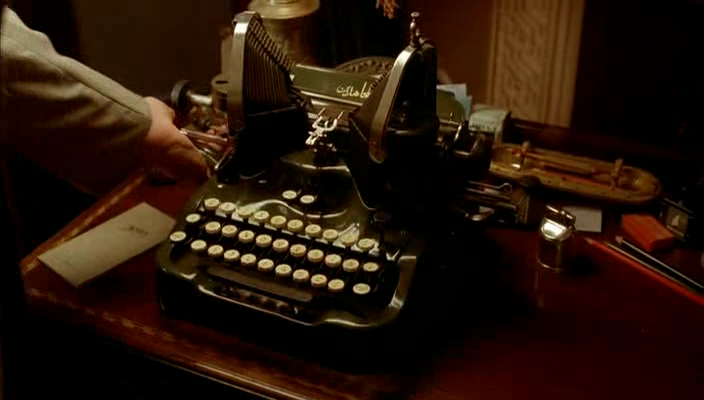
In David Cronenberg's/William Burrough's Naked Lunch, typewriters can morph into cockroaches, they can speak, they can move, they can spy on you and everything you write on them - they can even produce some interesting hallucinogenic substances for your enjoyment, should you want them to. Marvel at the scene below as one typewriter chews another to death.
1. ALL THE PRESIDENT'S MEN
All The President's Men is a classic story of investigative journalism; Bob Woodward and Carl Bernstein (Robert Redford and Dustin Hoffman) slowly unravel the Watergate conspiracy using a combination of phoning everybody they can think of and knocking on doors - and of course, typing it all up on their trusty 1970s typewriters. Best scene: Woodward comes over to Bernstein's apartment, turns on the radio and types out what he wants to say after being told by his undercover source that their lives are in danger and they may be under surveillance.
Coriolanus is Oscar nominated actor Ralph Fiennes' first stab at directing. He has chosen to make and star in a modernised version of the Shakespeare play 'Coriolanus', which centres on a Roman General named Caius Martius; he is a formidable soldier who is given the title 'Coriolanus' after laying successful siege to the Volscian city of Corioles. He is convinced to run for consul by his fame hungry mother Volumnia, and at first he is successful - but the scheming of other politicians, as well as his own sentiments regarding popular democratic rule, turn the mob against him. He is banished from Rome, eventually joining up with the Volscians in order to wreak revenge on the city that exiled him.
While Coriolanus has been given a modern setting (the city is still referred to as Rome, but in fact the film was shot in Belgrade, Serbia) as little as possible appears to have been changed from the original play. Of course everyone is dressed in modern clothing, and there are guns (lots of guns), but the costumes and sets are very sparse, as if every effort has been made to pare the film down; it has the definite ring of a modernised, minimalist theatre production of Shakespeare brought to the screen, rather than an actual translation of the play into film.
The dialogue is gold, as of course it would be, what with Shakespeare being the scriptwriter. As with all Shakespearian productions it's the performances that are the most scrutinised. Some of the bit part actors are clearly not comfortable with the Shakespearean language (a couple of seem to think they're in a school play), but that is made up for by the main performances. As usual, Vanessa Redgrave (as Volumnia) acts everybody else off the screen; Jessica Chastain (who was recently nominated for an Oscar for her role in The Help) does a pretty average job with Virgilia, the wife of Coriolanus. Gerard Butler (as Coriolanus' arch enemy Aufidius) spouts off his lines eloquently in his gravelly Scotch accent (he certainly wouldn't be miscast as MacBeth) although the best of the male supporting actors is almost certainly Brian Cox as Menenius.
Ralph Fiennes himself is certainly intense, but he does have a tendency to go a little bit over the top. Having previously played Coriolanus onstage (at the London Almeida Theatre in 2000) it seems likely that he is carrying over much of that performance to the screen, perhaps forgetting along the way that in a film you don't always have to yell and gesticulate wildly during emotional scenes to get your point across to the cheap seats. It may have been a mistake to give Coriolanus a shaved head as well; it's certainly striking and cinematic, but it smacks a little bit too much of his recent (and possibly most famous) role, Lord Voldemort, who was also as bald as an egg.
Although Coriolanus is probably an extremely good play, Fiennes has not translated it particularly well to the screen; the only scenes in which I found myself truly interested where the ones in which Vanessa Redgrave took control and showed off what over fifty years in the industry (plus being Michael Redgrave's daughter) can do. The trick with translating a play to film is to do something new with it, something that could only be done through the medium of film. Fair enough, you couldn't have a violent pitched gun battle onstage, and Fiennes and Butler probably couldn't jump through a glass window, but these are quite fleeting scenes and don't leave a very lasting impression (plus film can provide so much more than just cheap action sequences).
Coriolanus is a pretty good watch, but I wouldn't want to see it more than once. It's worth it for Redgrave's performance alone, but other than that there is nothing particularly remarkable about it. Fiennes seems to have got a taste for directing however; his new one The Invisible Woman, which tells the story of Charles Dickens' secret mistress, is coming out next year. Perhaps he'll make a more interesting job of it when he isn't hampered by the shadow of Shakespeare.
I named this list Top Ten: Most Unbelievable Moments in Film, but what I really wanted to name it was Top Ten: You've Got to be Fucking Kidding! Moments in Film. Allow me to explain.
My ex-Professor at the University of Exeter, Steve Neale (author of 'Genre and Contemporary Hollywood, among other things) once wrote an essay entitled 'You've Got to be Fucking Kidding!: Knowledge, Belief and Judgement in Science Fiction'. You can find this essay on page 160 of a book called 'Alien Zone: Cultural Theory and Contemporary Science Fiction Cinema'. As his starting point for this article Neale takes a scene from John Carpenter's 1982 film The Thing. For various very complex reasons, during this scene a severed human head grows insect-like legs, gets up and walks out of the room, upon which one of the astonished characters exclaims the immortal words: "You've got to be fucking kidding!" (see video above)
In that moment, the fourth wall cracks just a little bit; that character has given voice to what we were all thinking (they've gone a little far with that one/that was a bit over the top/you've got to be fucking kidding). This is a list of 'you've got to be fucking kidding' moments; some of them are unbelievable, some of them are awful, and some of them are just plain weird, but they are all moments that make you stop and think: hold the phone. What the hell's going on here?!
10. OLDBOY - The Wriggling Sushi
To start us off it's that classic of 2003, that darling of South Korean cinema, Chan-wook Park's Oldboy. More specifically, it's the scene where Oh Dae-Su (played by Min-sik Choi) goes into a restaurant and chows down on a live octopode; he goes to town on that thing, stuffing it into his mouth raw and wriggling, Gollum-style. Apparently Choi had to chew on four seperate octopodes during filming, and when the film won the Grand Prix at Cannes, Park thanked the dead sea-beasties in his acceptance speech (although they probably didn't appreciate it).
9. DON'T LOOK NOW - The Murderous Dwarf
The grisly denouement of Nicolas Roeg's 1973 horror film Don't Look Now has to be among the strangest and most wholly unexpected pieces of cinema to ever be filmed. Donald Sutherland and Julie Christie are wandering around Venice, haunted by what appears to be the ghost of their little drowned daughter. Of course, it isn't really their daughter, but a psychotic serial killing dwarf woman in a red duffle coat who slashes Sutherland's throat. Who woulda thunk it.
8. THE DAY OF THE DEAD - Choke on 'em!
In George Romero's Zombie follow-up The Day of the Dead (1985), the outside world is overrun by zombies while a small group of soldiers and scientists survive inside a military bunker. Eventually, cabin fever sets in and things start to gang awry; when zombies finally do breach the bunker, the head military honcho (who we don't like much, because he's an asshole) falls prey to their hunt for human flesh. Two of our zombified bretheren grab ahold of his legs, rip them off and begin dragging them away. Military Asshole (who's name, if you care, is Captain Rhodes) totally redeems himself in this scene with two and a half words: "Choke on 'em!" he screams, even as yet more zombies are tearing out his entrails.
7. THE EVIL DEAD - The Tree Rape
Even if you've never seen it, you've probably at least heard about it; the infamous 'Tree Rape' scene from Sam Raimi's 1981 video nasty The Evil Dead. Deemed so gratuitously horrible that versions of the film that include it are still banned in some countries, the Tree Rape scene really is just what it sounds like.
6. THE EXORCIST - The Spider-walk
Many of you who have seen The Exorcist may have never even heard of the Spider-walk - that's because it was cut from the original film due to the visible suspension wires holding up the stunt woman. These were removed digitally for certain re-releases of the film, and it is now possible to see the Spider-walk in all its creepy glory. Basically, twelve year old Reagan (Linda Blair), who is possessed by a demon claiming to be the Devil, takes it into her head to climb out of her bed and down the stairs on all fours - backwards. That may not sound too insane, but try watching the video above and see if it doesn't make you want to call your therapist.
5. THE WICKER MAN (2006) - Not the Bees!
In the rotten abortion that is Neil LaBute's 2006 remake of The Wicker Man, there is an utterly ridiculous scene in which Nicholas Cage (who is playing the Edward Woodward character) has a wooden frame tied around his head which is then pumped full of very angry bees (in the original film, the Pagan islanders are pissed because their apple crop has failed; in the remake, they're upset about their lack of honey - hence the bees). In what has to be one of the most hilariously cringeworthy scenes of all time, Cage goes on to yell, most unconvincingly, these exact words: "OH NO! NOT THE BEES! NOT THE BEES! AAAHHH! OH THEY'RE IN MY EYES! MY EYES! AAAHHH! AAARGH!" Nuff said. For God's sake, do yourself a favour: watch the original.
4. NAKED LUNCH - The Mujahideen
Ok, this one's going to take some explaining. First of all, Naked Lunch is a film by David Cronenberg (there's your first clue) based on a book by William Burroughs (there's your second clue) which is basically a drug/sex/writing fuelled romp of epic proportions (and there's number three). In Naked Lunch, typewriters are a big deal. In the film they are given personalities, even voices, and are able to act as spies for various agencies. The typewriters have a nasty habit of morphing into odd creatures, usually cockroaches or bugs of some type. There is a scene in which the Mujahideen (which is an arabic typewriter) morphs into...well, I don't quite know what the hell it morphs into. Some sort of fleshy beast, part human, part lobster? I don't know; we're talking Burroughs mixed with Cronenberg here - anything at all can and does happen. You'll have to watch it for yourself. All I can say is, you're left with a very strong desire to grab somebody else and say 'Did you see that shit, or was it just me?'
3. JAWS 3 - The Shark in the Fish Tank
In the third Jaws film, a big shark is back, and this time it has focused its attack on a marine resort rather like Seaworld (in fact, most of the film was actually shot at Seaworld). Of course, the resort is full of interconnected aquariums, which are in turn connected to the ocean, making it extra simple for the shark to swim right in and surprise the diners in the underwater restaurant by showing up in the tank next to them. That's right; an incredibly unconvincing plastic shark the size of a routemaster showing up next to your table just as you're all finishing up your starters. I wouldn't tip; would you?
2. DIE ANOTHER DAY - The Invisible Car
Probably the worst Bond film ever made (and let's face it, they were never exactly stellar to begin with). Producers the Broccolis went too far this time, one-upping themselves into oblivion with Bond's most ridiculous gadget ever: the invisible car. I'm convinced it was this awful addition alone which sparked the dumping of Pierce Brosnan and the old regime in favour of Daniel Craig and a slick new update of Casino Royale; the Bond Renaissance, if you will. All Bond needs is a gun, a Martini and a pack of cards; not invisible Aston Martins. How are you supposed to turn that into a collector's item anyway? Do you just sell the kids an empty box?
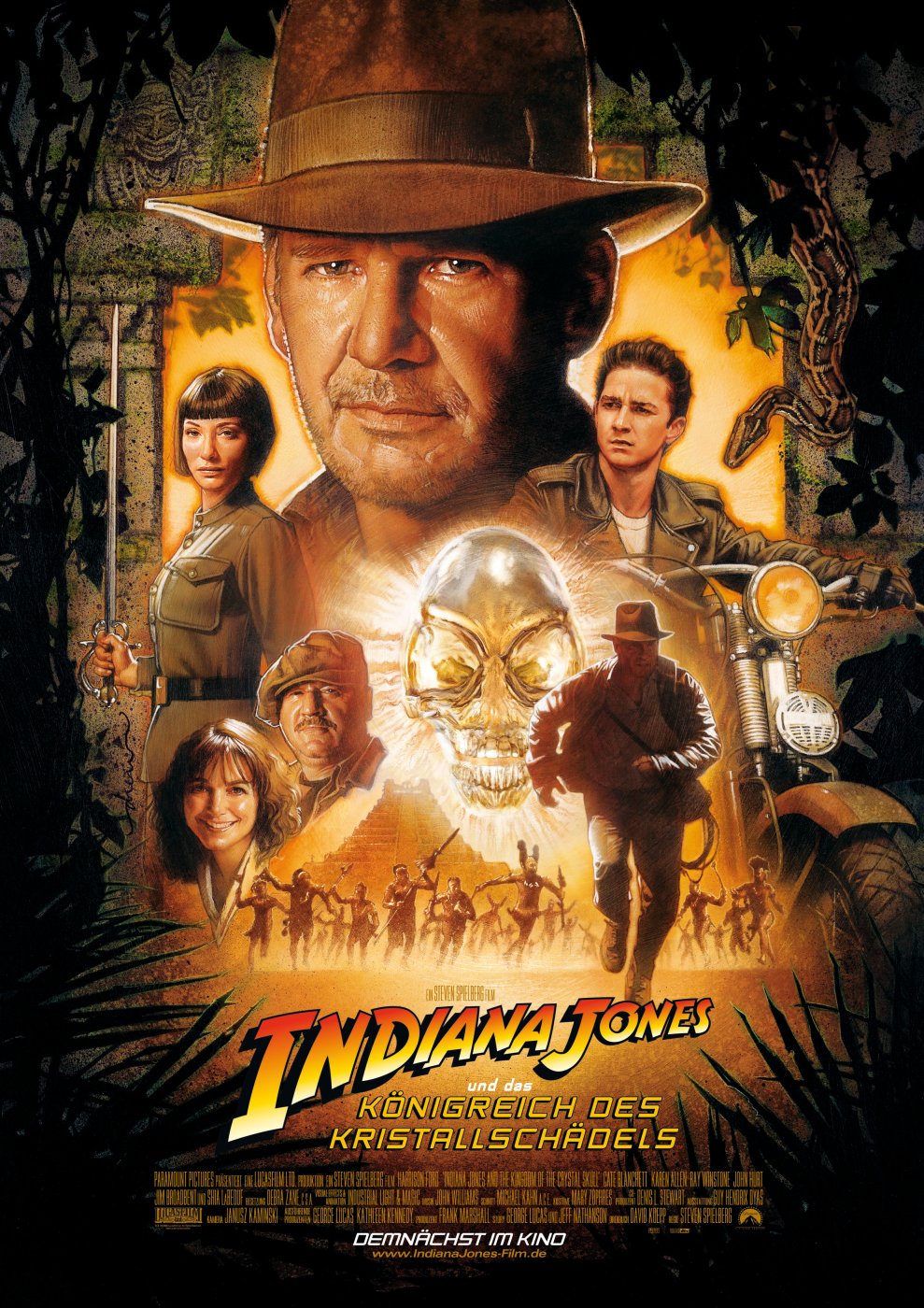
1. INDIANA JONES AND THE KINGDOM OF THE CRYSTAL SKULL - Nuking the Fridge
Lastly, of course, it had to be Harrison Ford surviving a nuclear blast by climbing into a lead-lined 1950s fridge. This scene is so utterly ridiculous, so head turningly unbelievable that it has actually given rise to the phrase 'nuking the fridge', which is not only used to refer to scenes in which film characters manage to survive the most unsurvivable situations in the most ridiculous ways, but also for scenes that are so awful that they ruin any subsequent enjoyment of the film. But, as I believe I have said before in another Top Ten list (Top Ten: Falls From a Great Height), it is impossible to kill Harrison Ford - I bet if some nut walked up to him and shot him point blank in the face, the hole in his head would just seal straight back up, like the T-1000 in Terminator 2.
Clint Eastwood's J. Edgar is not your average biopic - mostly because J. Edgar Hoover was not your average man. He was director of the Bureau of Investigation and later the FBI for over fifty years; during that time he instituted a centralised finger-printing lab, presided over the investigation of the Lindbergh kidnapping, and waged war against 'subversives and radicals', mostly under the banner of the fight against Communism. It eventually came to light that Hoover was massively exceeding his jurisdiction, collecting evidence illegally, and creating secret files on political leaders (which were destroyed after his death by his secretary Helen Gandy, played in J.Edgar by Naomi Watts).
J. Edgar tells the story of Hoover's rise to power, but it becomes clear as we watch that what the film is really interested in is his personal life. Ably played by Leonardo DiCaprio, Hoover is presented as a closeted gay man unable to deal with his desires. The film also suggests a platonic gay relationship between Hoover and his deputy director Clyde Tolson, played by Armie Hammer (who you will remember as the 'Winklevii' from David Fincher's The Social Network). While rumours and conjecture about Hoover's sexuality have abounded since the 1940s, it has never been conclusively proved that he was gay, or that he had a relationship with Tolson. There's no smoke without fire, however, and there was a hell of a lot of smoke surrounding the two men (I don't have room in this review to go into it all; check out Hoover's Wikipedia page for more information). And so, J. Edgar presents the secret relationship as fact, portraying Hoover as a powerful man with a distinguished (if controversial) career, haunted by his inability to accept his own sexuality.
The onscreen relationship between Hoover and Tolson is quite well done, but not nearly strained enough. An angst ridden, unfulfilled onscreen relationship is ample opportunity for clandestine awkwardness and meaningful silences, but these are never made use of with great effect. There is one very good emotional scene in which glasses and punches are thrown, but the relationship has been made into the crux of the film, and it's just not strong enough to hold it up single handed for two and a half hours - plus, there is little else to back it up with.
Many biopics use the trope of the protagonist looking back on their life in old age (in the case of Hoover, he is narrating his political career to a series of young male typists), but few manage to do it with such fragmentary confusion as J. Edgar. I'm not saying we need the year to flash up on the screen every five minutes, just that the jumping back and forth between time periods should be done with a little more care. There are a couple of significant straight cuts between 'old' Hoover/Tolson and 'young' Hoover/Tolson (a particularly good one shows the old pair getting into an elevator, and then the young pair getting out) but for much of the film the framing device seems almost arbitrary; a chronological biopic would perhaps have been far more direct and effective.
The quality of the make-up used to transform DiCaprio and Hammer from thirty-somethings to seventy-somethings really isn't good enough to sustain the amount of time they spend onscreen as their 'old' selves; the actors were clearly being inhibited by the amount of putty they had spread over their faces. DiCaprio is not at his finest in this film, but his average performance these days is still another man's powerhouse. He gets the voice down exactly, drawling away in a perfect early 20th century East Coast twang, but even this gradually becomes a hindrance to the film. There is altogether too much talking in J. Edgar; Eastwood knew he was onto a good thing with DiCaprio's voice and overused it to distraction. Hoover's relationship with his mother (Judi Dench) is portrayed as too close for comfort; this is on purpose, but Hoover's constant refrain of "Yes, Mother" (plus the over the top scene in which the famous transvestism rumour is touched upon) gets a little too close to the territory of Anthony Perkins in Psycho.
Unfortunately, J. Edgar is a film which forces me to use the phrase I keep in reserve for movies that might have been impressive but for a number of inescapable flaws: it had its moments. If you want to see a truly great 20th century American political film, try Frost/Nixon, or All The President's Men - J. Edgar isn't going to be joining them any time soon.