Saturday, 7 April 2012

Top Ten: Trains in Film

Everybody loves trains - well, not these days perhaps. These days, they're mostly just great metal tubes full of sweaty kindle-readers, crumpled Metros and the odd pool of fresh (or not so fresh) vomit. But, in the good old days, they were truly the transport of kings. Here are ten of the best. Or at least, ten of the best films that have trains in them.

10. The Great Train Robbery (1903)


From the famous Edison Manufacturing Company, The Great Train Robbery is one of the earliest surviving examples of American cinema (the original camera negative is held by the Library of Congress, and new prints can still be made from it). It's just over ten minutes long, and tells the story of a group of cowboy gangsters who hold up a train and rob the passengers. Some scenes include colour; the tints were painted onto the film by hand.

9. Arrival of a Train at La Ciotat (1896)


Lumiere's Arrival is so famous that even people with no interest in film history whatsoever are likely to have seen it, or at least have heard about it. The film runs for just under a minute, and shows the arrival of a train at a station where a line of people wait to greet it. The famous story about the first screenings of this film (that some audience members ran out of the theatre for fear they would be crushed by the oncoming locomotive) is certainly exaggerated. However, a quotation from July 14th 1896 in the French newspaper Le Courier du Centre reads "...spectators draw back instinctively fearing they'd be run over by the steel monster."

8. In the Heat of the Night (1967)


They call him Mr Tibbs. While waiting to train it out of Sparta, Mississippi, police detective Virgil Tibbs (Sidney Poitier) falls afoul of the local police force. Once they realise who he is, the racist cops reluctantly ask for his help in solving a local murder. The tension boils over in this brilliant and racially explosive film

7. The Third Man (1949)


Holly Martins (Joseph Cotten) arrives in Vienna on a train as the nameless narrator (who never shows up again) babbles on about Vienna:

I never knew the old Vienna before the war with its Strauss music, its glamour and easy charm. Constantinople suited me better. I really got to know it in the classic period of the black market. We'd run anything if people wanted it enough and had the money to pay. Of course, a situation like that does tempt amateurs. But, well, you know, thay can't stay the course like a professional. Now the city is divided into four zones, you know, each occupied by a power: the American, the British, the Russian and the French. But the centre of the city, that's international, policed by an international patrol. One member of each of the four powers. Wonderful! What a hope they had. All strangers to the place and none of them could speak the same language. Except a sort of smattering of German. Good fellows on the whole, did their best you know. Vienna doesn't look a whole lot worse than a lot of other European cities; bombed about a bit. Oh, I was going to tell you, wait, I was going to tell you about Holly Martins, an American. Came all the way here to visit a friend of his. The name was Lime, Harry Lime. Now Martins was broke and Lime had offered him some sort, I don't know, some sort of job. Anyway, there he was poor chap, happy as a lark and without a cent.

6. Strangers on a Train (1951)
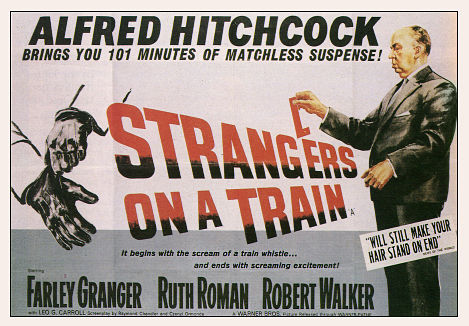

In Hitchcock's suspenseful tale, two men meet on a train and make a pact; they will each murder the other's wife, figuring that since motive can't be proved, they will both be able to get off scott free. In the opening of the film, the camera follows only the feet of the two men as they get onto a train, cutting to a tracking shot of the track (ha) until the two pairs of feet finally collide.

5. Brief Encounter (1945)
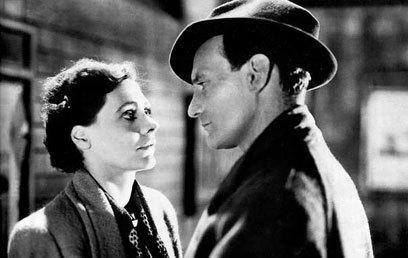

Celia Johnson and Trevor Howard are tempted to cheat on their spouses when they run into each other at a train station. They continue to meet each other every thursday at the station cafe, even though they know their romance is doomed. Trains and stations feature heavily in this tense and tragic film, places filled with guilt and separation.

4. Cabaret (1972)


Brian (Michael York) arrives in Berlin on a train, he and Sally (Liza Minnelli) like to spend their free time standing underneath a railway bridge and screaming at the top of their lungs every time a train goes by, and Brian later leaves Berlin by train - but, other than that, trains don't feature too heavily in this lively musical, made in 1972 but set in Weimar Germany. If you like Otto Dix, turquoise nail varnish, prairie oysters, intra-war malaise, a good portion of campy singing and dancing, and the odd sprinkling of Nazis, then this is the film for you.

3. Once Upon a Time in the West (1968)


Come on, we all remember Once Upon a Time in the West and its incredible opening sequence. If you don't, I'd suggest watching the above video - there's no proper way to explain it in words.

2. Double Indemnity (1944)
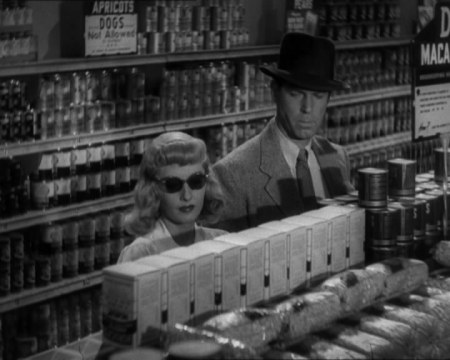

Walter Neff (Fred McMurray) is an insurance salesman who becomes entangled with the married, blonde and dangerous femme fatale Phyllis Dietrichson (Barbara Stanwyck). The two plot to murder Phyllis' husband and then make it look like an accident by throwing him off the back of a train. Needless to say, their plan begins to go wrong, and Walter's boss Barton Keyes (Edward G Robinson) starts to smell a rat...
1. The Railway Children


 Oh yes I did. Number one, it has to be: The Railway Children. The Waterbury family are forced to move to a small cottage in Oakworth after their father is arrested and falsely imprisoned for treason. Needless to say, at the end of the film the whole mess is sorted out, and Roberta meets her father at the station following his release. If you can watch the above scene and not well up, you have no place on this planet.

Friday, 6 April 2012

The Multiplex Vs The Indie Cinema

Watching a film in a theatre is all about the cinematic ‘experience’; the big screen, the surround sound, the effects of IMAX or 3D (or even both). There is a wide variety of cinemas to choose from in the UK, but does the type of theatre actually make much of a difference? When it comes to the multiplex vs. the independent cinema, is one really better than the other?


Film critic Mark Kermode went through so much trouble while queuing at his local cinema complex that in the introduction to his book, ‘The Good, the Bad and the Multiplex’, he was moved to write:

‘I was suddenly filled with a vision of a great gaping void… This was presumably the void of which Nietzsche was thinking when he warned us that “when you look long into an abyss, the abyss looks right back into you.” Right now, the abyss was indeed looking back into me, apparently eager for me to get out of the way so that it could look long into the person standing behind me in the queue, who probably wanted two tickets and an industrial-sized vat of popcorn.’

Many hardened film-goers will be familiar with these sentiments; sometimes a multiplex cinema can seem a little too much like a fast food restaurant, shovelling films down the throats of the masses in easy to swallow chunks. But what are the real differences between the multiplex and the indie theatre?

To read the rest of the article, head over to Movie Farm

Thursday, 5 April 2012

10 Life Lessons from The Big Lebowski

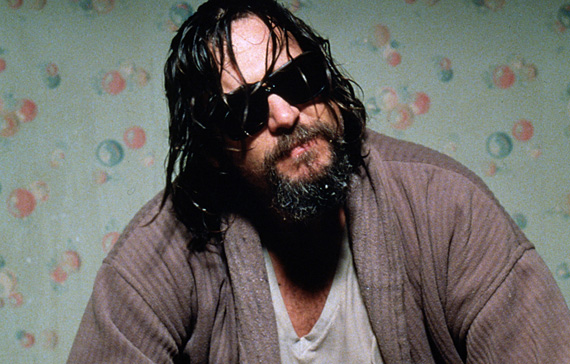
We can learn a lot from films. How to smoke cigarettes, use a record player, build yourself a rudimentary bomb - these are all things that can be picked up from the silver screen alone. But, we can also learn important skills that will stand us in good stead as we move through the unbearable cavalcade of horror that is called life. So put on your dressing gown, mix yourself up a White Russian, and appreciate your favourite rug while you can, as you revisit some home truths from The Big Lebowski. The Dude abides.


1. Always deliver results

"I can get you a toe by three o'clock this afternoon. With nail polish."


2. Appreciate the little things

"That rug really tied the room together."


3. Never be afraid to show emotion

"Strong men also cry... strong men also cry."


4. Play by the rules - when it suits you

"This is not 'Nam. This is bowling. There are rules."


5. Don't sugarcoat the truth, even for your friends

"Walter, I love you, but sooner or later you're going to have to face the fact that you're a Goddamn moron."


6. Don't let people take you for a ride

"Just because we're bereaved, that don't make us saps!"


7. Always remember what you owe to people

"Lady, I got buddies who died face down in the mud so that you and I could enjoy this family restaurant!"


8. Learn to take the good with the bad

"Sometime you eat the bear, and sometimes, well, he eats you."


9. When you're in a hole, stop digging

"I could just be sitting here with pee stains on my rug."


10. Always know when to apologise

"I'm sorry your stepmother is a nympho."

Wednesday, 4 April 2012

Top Ten: Pedro Almodovar Characters


Last week I was working on a top ten list of Almodovar characters when the director suddenly 'died' - see my post Almodovar: Latest Victim of Social Network Slasher. Thankfully, Almodovar is NOT dead, and here is first part of the top ten that I wrote for Subtitled Online. Enjoy.

Tuesday, 3 April 2012

The Woman in Black Sequel Given the Green Light


Following the box office success of spine-chilling ghost story The Woman in Black, famous horror production company Hammer has given the green light for a sequel.

The first film, which starred Daniel Radcliffe (the globally recognisable face of Harry Potter), was a slow burner at the box office, but has so far made $112 million worldwide, £20 million in the UK alone, a figure which is still on the up. This makes Woman in Black not only the most successful Hammer film ever produced, but also the most successful British horror movie of the last twenty years. Understandably, this has got the business minds at Hammer very excited, and no doubt fuelled their decision to produce a sequel...

For the rest of the article head over to Movie Farm

Monday, 2 April 2012

Game of Thrones | Season 2, Episode 1: The North Remembers

This post is about the first episode of the second season of Game of Thrones, which won't air in the UK until tonight, so MASSIVE SPOILER ALERT


Spring has arrived, but Winter is coming. What else is there to blog about today except for the return to the small screen of HBO's Game of Thrones, the epic historical fantasy series from the pen of George R. R. Martin, adapted for television by David Benioff and DB Weiss. If you thought the titanic struggle for the Iron Throne, currently taking place between nine houses, five kings, and seven kingdoms, was as complicated as it could get, you were wrong; it's about to become hugely, vastly, incredibly complicated.

A bright red comet in the sky is interpreted as an omen of the coming bloodshed (or possibly, the birth of dragons). Stannis Baratheon, played by Stephen Dillane, is the new big thing. Younger brother of Robert and older brother of Renly, Stannis is the man Ned Stark believed to be the rightful heir to the Iron Throne, after it was revealed that due to Jaime and Cersei Lannister's incestuous dealings, Robert had no trueborn heirs. Stannis was one of the few people Ned chose to let in on the secret before Joffrey had his head lopped off. The first act we see Stannis perform is sending out letters to every Tom Dick and Harry to tell them that Joffrey, Tommen and Myrcella are the inbred bastards of the Lannister Twins (a pretty smart move).

Meanwhile, Jon Snow is on his way into the real North with his brothers in black, searching for his missing uncle Benjen.Tyrion Lannister, now the Hand of the King in his father's stead, turns up in King's Landing. He is understandably very chuffed with himself, relishing his new found power and taking immense pleasure in the look on his sister's face when she finds out she now has to obey the orders of her diminutive sibling.

The Wolves are starting to get big; like, as big as a rather large Shetland pony big. Robb Stark, who is struggling a little bit to get everybody to call him 'Your Grace' after being styled the King in the North in the final episode of the first series, uses his wolf Grey Wind to intimidate Jaime Lannister, who is still his prisoner (and looking decidedly worse for wear). Bran is still stuck at Winterfell, performing the Lord's duties, speculating about the comet, and having even more prophetic dreams, this time involving direwolves and the Godswood.

On the other side of the narrow sea, Dany is struggling to keep her tiny Khalasar together in the face of the Red Waste. Plus she can't work out what to feed her three baby dragons, who are apparently turning their fiery noses up at everything she offers them (is it my imagination, or was she breastfeeding them in the last episode? She must be trying to wean them, I suppose - there must be all sorts of bother involved in breastfeeding a dragon).

That horrible munchkin Joffrey has let Kinging go to his head a little, having people killed left right and centre, tormenting Sansa (who seems to have gone a bit catatonic, although she is learning how to manipulate Joffrey), and even starting to disobey his mother, who makes the mistake of slapping him in the face. He also goes Biblical on us by ordering the murder of all of Robert Baratheon's bastards, including the newborn babies, in a King Herod style massacre. They are all wiped out except, of course, for that dashing young armourer who is currently on his way to the wall, accompanied by a cross-dressing Arya Stark.

While this epsode was mostly setting the scene for the bigger events to come, it was still pretty riveting - the writers are doing amazingly well to keep so many different strands of the story in check. And so begins another ten weeks of magical medieval madness in the world of Westeros - if nothing else, it'll distract from the hellish soul-crushing boredom of your own existence for an hour a week.

If you need any more motivation than that, check out my Ten Good Reasons to watch Game of Thrones article.


Episode 1 Best Moment: Robb sets Grey Wind on Jaime

Episode 1 Best Line: Tyrion to Cersei: "You love your children. It's your one redeeming quality; that and your cheekbones."

Game of Thrones | Episode 2: The Night Lands

Sunday, 1 April 2012

Catching up with the Future: A Sci-Fi Timeline


Apparently, the world is going to end this year. To be exact, it’s going to end on the 21st of December 2012. Cineastes the world over are already bemoaning this utter catastrophe; it means we will survive just long enough to be able to catch a screening of The Hobbit: An Unexpected Journey (which will be released in the UK on December 14th), but have absolutely no chance of being around for the sequel, There and Back Again (which won’t hit the cinemas until 2013). Still, we wouldn’t worry about it too much – as film fans, we already know that the world can’t end in 2012. In fact, it’s impossible; science fiction tells us that our future is only just beginning...

Read more at Movie Farm...